Paediatric Medicines Under the EU Legislative Reform
Published Oct 01, 2026
Published 24th September 2024
This article provides an overview of the EMA scientific advice and protocol assistance procedure, highlighting the application process and the key differences between scientific advice and protocol assistance. Protocol assistance is the special form of scientific advice available for developers of designated orphan medicines for rare diseases. The article summarises the key elements of the procedures including pre-submission considerations such as a preparatory meeting, the evaluation phase and post advice actions. We also discuss the Joint Scientific Consultation procedure, and the impact of the EU Pharmaceutical Reform on the scientific advice and protocol assistance procedures.
Scientific advice is a very powerful tool for developers of medicinal products. Not only does it guide the developer through the challenges encountered during development, but it also establishes relationships with regulators. The advice will certainly have a positive impact on the development and will enable the developer to streamline their process, ensure a high rate of compliance with regulations and will reduce the risk of Marketing Authorisation Applications being rejected. Whilst the advice is not legally binding, there will be a high expectation that the advice given by EMA will be addressed during development. In the context of the EU Health Technology Assessment Regulation, scientific advice is increasingly central to ensuring that clinical development programmes are aligned not only with regulatory expectations for marketing authorisation, but also with future EU level Joint Clinical Assessment (JCA) requirements for market access across Member States.
Scientific advice is a process whereby medicine developers can ask EMA specific questions related to their proposed development plan. Questions typically fall into the development strategy, quality, clinical and non-clinical areas although many questions can fall into more than one area, for example qualification of an impurity. The advice is prospective in nature and EMA does not pre-evaluate results which will be submitted later in development.
Protocol assistance is the term for scientific advice sought for medicines with an orphan drug designation. The same principles and process relating to regular scientific advice apply and additionally, applicants may seek the Agency’s input on topics relating specifically to orphan development such as:
The fees for scientific advice can be significant and details can be found on the EMA website. Significant fee reductions (up to 100%) are available for micro, small and medium size enterprises (SMEs) and designated orphan medicinal products. DLRC group can help developers assess whether they may qualify for these fee reductions and are able to apply for SME status for the developer.
Scientific advice is co-ordinated and managed by the EMA’s Scientific Advice Working Party (SAWP) who delivers the advice after adoption at the regular Committee for Medicinal Products for Human Use (CHMP) meetings. There are approximately 11 opportunities per year to obtain scientific advice which is adopted at the monthly meetings of the CHMP. The timings are strict and applicants who miss the allocated submission dates (published on the EMA website) even if late by only one day, will need to wait until the next cycle.
From January 2025, Joint Clinical Assessments have become mandatory for new oncology medicines and advanced therapy medicinal products, with the number of JCAs expected to scale significantly in 2026. The JCA runs in parallel with the EMA marketing authorisation procedure and provides a single EU level assessment of relative clinical effectiveness that will inform national HTA and reimbursement decisions. Under the EU HTA framework, developers may request Joint Scientific Consultations (JSC) with EU HTA bodies, either standalone or in parallel with EMA scientific advice. JSCs provide early guidance on clinical trial design, comparator selection and endpoints that are likely to be considered appropriate for EU level Joint Clinical Assessment under the PICO (Population, Intervention, Comparator, Outcomes) framework. Applicants may also seek advice on the demonstration of significant benefit within the scope of the designated orphan indication in the JSC procedure.
While scientific advice and JSC are voluntary, early regulatory – HTA alignment significantly reduces downstream risk during the compressed JCA timelines that run in parallel with the EMA centralised procedure.
Further details can be found on the EMA Scientific Advice homepage.
When sponsors require advice relating to clinical trial strategy or Clinical Trial Applications (CTAs), advice has traditionally been sought from individual National Competent Authorities (NCAs), who remain responsible for the assessment and authorisation of CTAs in the EU.
Under the Accelerating Clinical Trials in the EU (ACT EU) initiative, regulatory advice pathways have been significantly expanded and consolidated. In addition to the SAWP – Clinical Trial Coordination Group (CTCG) pilot and the Pre CTA advice pilot, the EMA has now formalised a further route: Emergency Task Force (ETF) Scientific Advice facilitating Clinical Trial Authorisations (SA CTA). The SA CTA route applies to products within the remit of the EMA ETF and supports the alignment of regulatory expectations across Member States, ethics bodies and the EMA for both CTA and MAA relevant considerations.
Collectively, these mechanisms reflect a shift towards more integrated, pan European scientific advice, reducing fragmentation between development, marketing authorisation pathways, and market access.
Joint scientific advice with EMA and FDA may also be sought, with a view to aligning global development programmes.
An overview of the scientific advice procedure is given in the guidance document ‘European Medicines Agency Guidance for Applicants seeking scientific advice and protocol assistance (EMA/4260/2001 Rev. 14).’ The following figure summarises the two phases of the procedure.
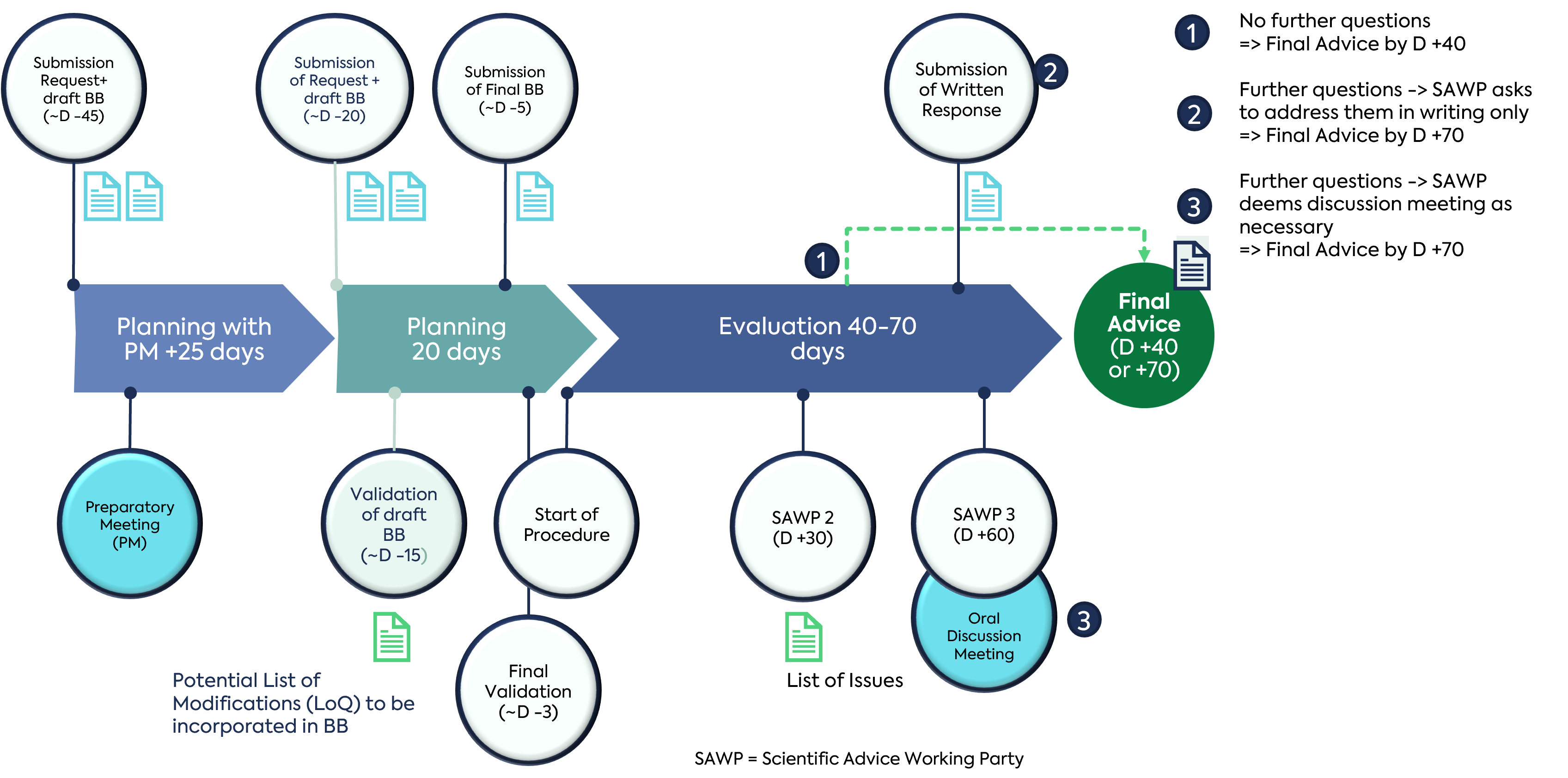
An optional preparatory telecon can be requested at the time of submission of the application for scientific advice. The preparatory meeting offers applicants the opportunity to establish contact with Agency staff and subject matter expert (SME) assessors and to receive feedback on several topics, including the appropriateness of the content and scope of questions and the related applicant’s positions, identification of additional issues to be included in the request, and the opportunity to ask regulatory questions which are outside the scope of scientific advice. This preparatory meeting may be the only direct communication that the applicant has with the agency and can be extremely useful. Many clients resist having a preparatory meeting due to the additional time required but this should be balanced against the benefit of a meeting which increases the likelihood of a Day 40 outcome, as the EMA has helped to shape the questions and briefing book content.
Our experience of preparatory meetings highlights the importance of a succinct presentation that highlights the key points of the development and the rationale for the questions posed. We have supported clients in preparing for preparatory meetings in order to maximise their value. It is important to note that the preparatory meeting is about listening to feedback so that the briefing book and questions can be optimised and is NOT about defending the clients positions.
A unique feature of the procedure with the EMA is that the briefing book must be submitted with the initial application. Generally, for scientific advice with individual NCAs, the draft briefing book is submitted with the initial application and the final version before the procedure start. There is a mandatory EMA template for the briefing book. The template provides guidance text, however our experience has helped clients identify the critical information to include, identifying the most appropriate questions and also develop a succinct stand-alone applicants position for each question.
To avoid unnecessary validation comments, it is important to consider carefully the wording of the proposed questions to be included in the advice request. Questions which are worded in the sense of a pre-assessment of data should be avoided.
The main purpose of this initial phase is to secure a briefing book which has been reviewed by the EMA and is found to be acceptable for the evaluation phase and is hence, validated.
Applicants should also be aware that scientific advice submissions are managed through the EMA’s IRIS platform.
After validation of the application, the evaluation process starts and is classified as Day 0. The reports are discussed at the next months SAWP meeting and then adopted at the next CHMP meeting which will be around Day 40. If the SAWP decides there is the need for a discussion meeting, this will be held after the CHMP meeting but before the next CHMP meeting, hence the advice will be adopted around Day 70 of the procedure.
If aspects of the written advice received are unclear or ambiguous, it is possible to request a clarification, with minor clarifications being addressed in writing in an expedited manner, and major clarifications being addressed at the following SAWP meeting. Any new data, information or a new applicant’s position would usually require a follow-up advice procedure.
In December 2025, the European Parliament and the Council reached political agreement on the most significant reform of EU pharmaceutical legislation in over twenty years. The revised framework is expected to enter into force in 2026, with transitional arrangements extending to 2028.
Scientific advice features prominently within the agreed reform package as a tool to improve development efficiency, regulatory predictability and patient access.
Confirmed elements relevant to scientific advice include:
These reforms reinforce scientific advice as a critical strategic component of EU medicine development, particularly for products addressing unmet medical needs, rare diseases or complex clinical development challenges.
There is a strong correlation between the success of marketing authorisation applications and applicants following EMA scientific advice, therefore seeking Scientific Advice during drug development is highly recommended. There are several routes to obtaining advice from Regulatory Authorities, such as advice from National Competent Authorities or EMA scientific advice (as summarised in this article.). In order to provide optimal value from seeking scientific advice, it is important for applicants to understand the nuances of the process, including the value of the preparatory meeting, the most appropriate questions to ask, how to provide optimal company positions in the briefing book, in addition to navigating the procedure and understanding if any follow-up actions are required.
If you are considering seeking scientific advice on your drug development program, DLRC’s extensive experience in helping clients navigate the scientific advice process will ensure that you obtain optimal input from the Regulators and HTA bodies.
Contact DLRC’s team of award-winning regulatory professionals via the link below, or email hello@dlrcgroup.com.


Published Oct 01, 2026

Published Sep 21, 2026

Published Sep 02, 2026

Published Aug 19, 2026

Published Aug 05, 2026

Published Jul 27, 2026

Published Jul 21, 2026

Published Jul 13, 2026

Published Jul 07, 2026